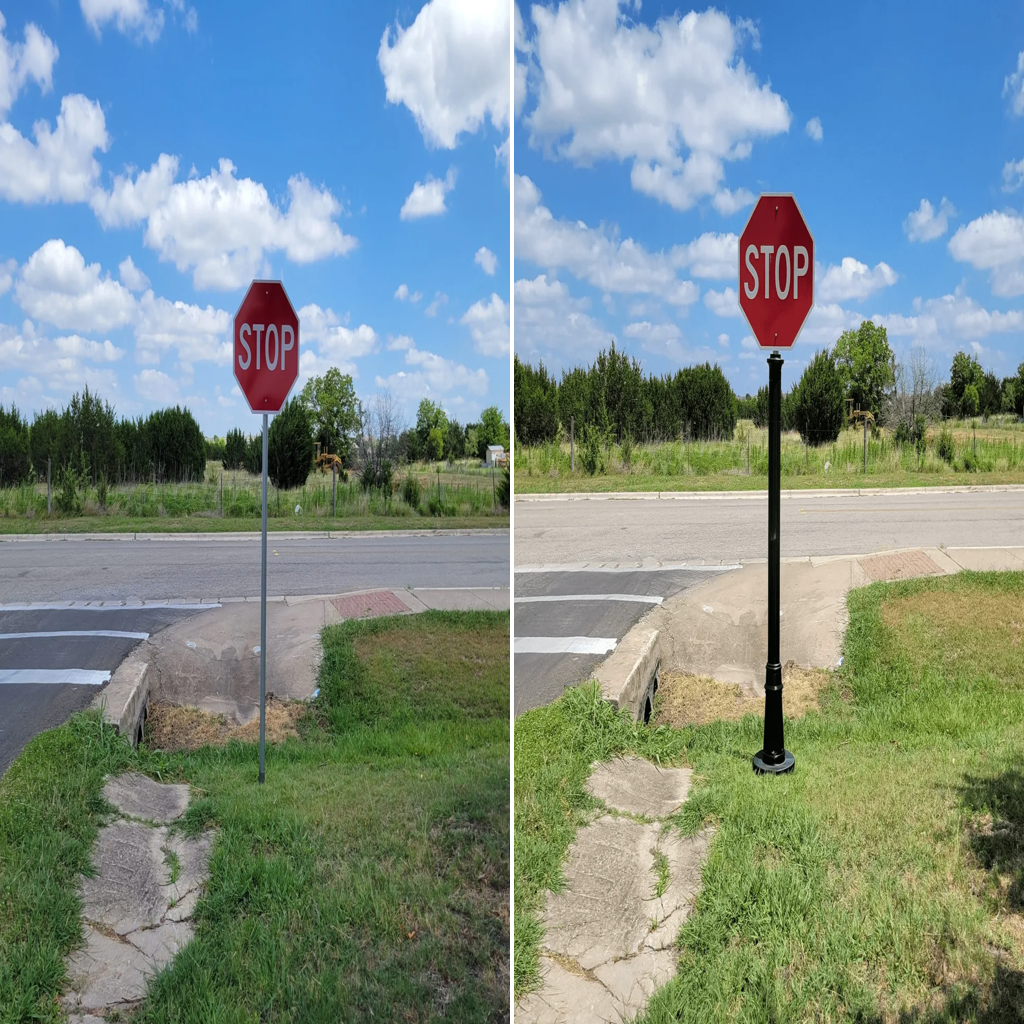
Livingston downtown revitalization and wayfinding signage: what this kind of project signals for municipalities
A recent project signal noted plans to improve downtown Livingston with revitalization efforts and enhanced wayfinding signage. That kind of announcement matters beyond one location because it reflects a broader municipal pattern: cities want downtown districts to feel more organized, more welcoming, and more visually consistent.
For public works teams, planners, and specifiers, wayfinding is not just about adding directional information. It is also about how the entire sign system looks once it is installed in the streetscape. Posts, brackets, and visible hardware can either support a polished downtown appearance or distract from it.
That is where sign post covers become part of the conversation.
Why wayfinding projects often expose a streetscape detail problem
When downtown revitalization moves from concept to installation, attention usually goes first to message design, sign placement, pedestrian flow, and district branding. But once signs are in the field, the supporting post can become a visual issue.
In many downtown environments, municipalities are working with existing infrastructure and practical budget constraints. That means they may not want to replace every post just to improve appearance. They may need a lower-disruption way to make streetscape signage look more finished.
This is especially relevant when:
- older sign infrastructure remains in place
- new wayfinding panels are being added to existing corridors
- visible post hardware clashes with downtown beautification goals
- public works teams need an upgrade path that is practical to install
A sign system can carry good information and still look incomplete if the supporting post does not match the intended streetscape character.
A retrofit mindset fits many downtown improvement programs
Not every city starts from a blank slate. In fact, many downtown projects are phased, budget-aware, and built around improvements to existing assets. That is why retrofit-friendly products matter.
Pole Covers describes its product as snap-around decorative plastic covers for standard sign posts, including U-channel, round, and square posts. The company also states that Pole Covers install without replacing existing posts.
For municipal and public works teams, that is an important distinction. It means sign-post appearance can be addressed as part of a broader streetscape refresh without automatically turning the work into a full post replacement project.
In practical terms, this can support goals such as:
- improving visual consistency along a downtown corridor
- reducing the unfinished look of exposed posts
- upgrading sign appearance during phased revitalization work
- aligning wayfinding improvements with downtown beautification efforts
Where the Spartan Pole Cover fits
For teams evaluating options, the relevant product page is the Spartan Pole Cover.
Current approved product truth is specific: there is one standard black Spartan Pole Cover. Custom color is only a feasibility discussion for 100+ units. That matters for specifiers because it keeps expectations clear during early product review.
In a downtown context, a standard black finish can be useful when the goal is a cleaner, more uniform post appearance that visually steps back and lets the signage do the communication work.
Because the Spartan product is presented as a cover rather than a replacement post system, it aligns with the needs of teams looking at retrofit-based streetscape signage improvements.
Why appearance matters in downtown wayfinding
Wayfinding signage is highly visible. Residents, visitors, business owners, and elected officials all notice it. In a revitalization setting, details matter because the public often reads them as signals of overall project quality.
A downtown district may invest in:
- directional signs
- parking guidance
- pedestrian information
- destination markers
- district identity elements
If those signs are supported by exposed or inconsistent posts, the installation may not fully deliver the intended visual effect. For that reason, post treatment can be part of a more complete streetscape strategy.
This does not mean every project needs a decorative solution. It means that when appearance is part of the project objective, the post should be considered alongside the panel, layout, and location.
A municipal proof point that supports the category
Pole Covers states that the City of McAllen, Texas deployed more than 200 Pole Covers across city facilities and downtown. That is a useful municipal proof point because it shows the product category is relevant in real public-sector environments.
It also supports a practical takeaway for public works teams: sign-post appearance is not only a niche design concern. It can be part of a visible citywide or district-level improvement effort.
For municipalities thinking about downtown revitalization, that kind of example helps frame how a relatively focused upgrade can contribute to broader presentation goals.
What to review during specification or evaluation
If your team is looking at sign post covers for a downtown or civic district, a few questions are worth discussing early:
1. Is the project retrofit-oriented?
If the goal is to improve sign-post appearance without replacing existing posts, a cover-based approach may be more aligned than a full infrastructure swap.
2. Are the existing posts standard sign-post types?
Pole Covers states compatibility with standard sign posts, including U-channel, round, and square posts. That makes existing field conditions an important early review point.
3. Is visual consistency a project objective?
In revitalization and wayfinding work, consistency across blocks often matters as much as the sign face itself.
4. Is installation disruption a concern?
Pole Covers positions its products as designed for visible, low-disruption streetscape upgrades. For active downtown areas, that can be relevant to planning and sequencing.
5. Is the team comfortable with the current standard product offering?
For the Spartan product, approved product truth is one standard black version. If a project is expecting multiple standard finishes, that expectation should be corrected early.
Using Livingston only as a market-context signal
The Livingston project signal is useful because it highlights a familiar municipal priority: combining downtown revitalization with improved wayfinding signage. It should be treated as market context, not as evidence of product selection, purchase, or customer status.
That distinction matters. Municipal teams regularly study public projects in other communities to identify planning patterns and implementation ideas. In this case, the key lesson is simple: when a city works on downtown wayfinding, sign-post appearance can become part of the broader streetscape conversation.
A practical takeaway for public works and downtown stakeholders
If a municipality is planning or refreshing wayfinding in a downtown setting, it is worth evaluating not only what the signs say, but also how the posts will look after installation.
That is especially true when goals include:
- downtown beautification
- tourism presentation
- corridor consistency
- phased revitalization
- low-disruption visual upgrades
For teams that want to explore a retrofit-oriented product, the Spartan Pole Cover is the most relevant starting point. A broader company overview is also available at Pole Covers.
In many municipal projects, the most effective streetscape improvements are not always the most complex. Sometimes they come from addressing the highly visible details that shape how the public experiences a place every day.