What a Downtown Portland Wayfinding Update Signals for Streetscape Specifiers
A recent public project signal from Portland, Oregon points to a familiar municipal pattern: once a public space gains attention, wayfinding and related streetscape details often follow. In this case, a Portland Tribune report described wayfinding signage being added through the PSU sign shop, along with planned directional signs around Oak Savanna in connection with downtown Portland’s first dog park.
For municipal staff, public works teams, and specifiers, that kind of update is not just about messages on the sign face. It is also a reminder that post appearance, exposed hardware, and visual consistency can become part of the public’s experience of a downtown space.
This article uses that Portland signal only as context. It does not suggest that Portland is using Pole Covers or evaluating them. Instead, it highlights a broader specification question: when wayfinding signage is added or refreshed, should the team also evaluate the look of the supporting sign posts?
Why wayfinding projects often trigger broader streetscape review
Wayfinding signs are highly visible. They are often placed where people pause, cross streets, orient themselves, or enter a civic space. Because of that, the support structure matters more than teams sometimes expect.
In many downtown or park-adjacent environments, the sign panel may be new while the post beneath it remains utilitarian and exposed. That can be perfectly functional, but it may not always align with a streetscape improvement effort that is trying to create a more finished appearance.
That is why sign-post appearance tends to come up during:
- downtown beautification efforts
- public realm refreshes
- park and trail wayfinding additions
- gateway and directional sign programs
- phased sign replacement projects
If a jurisdiction is already coordinating sign placement, graphics, approvals, and installation access, it may be an efficient point to ask whether existing sign posts should remain as-is or receive a retrofit treatment.
A retrofit-minded approach to sign post appearance
One reason post upgrades enter the discussion is that full post replacement can create unnecessary scope. In many projects, the goal is not to redesign the sign support system from scratch. The goal is simply to improve the visible condition or appearance of standard posts already in place.
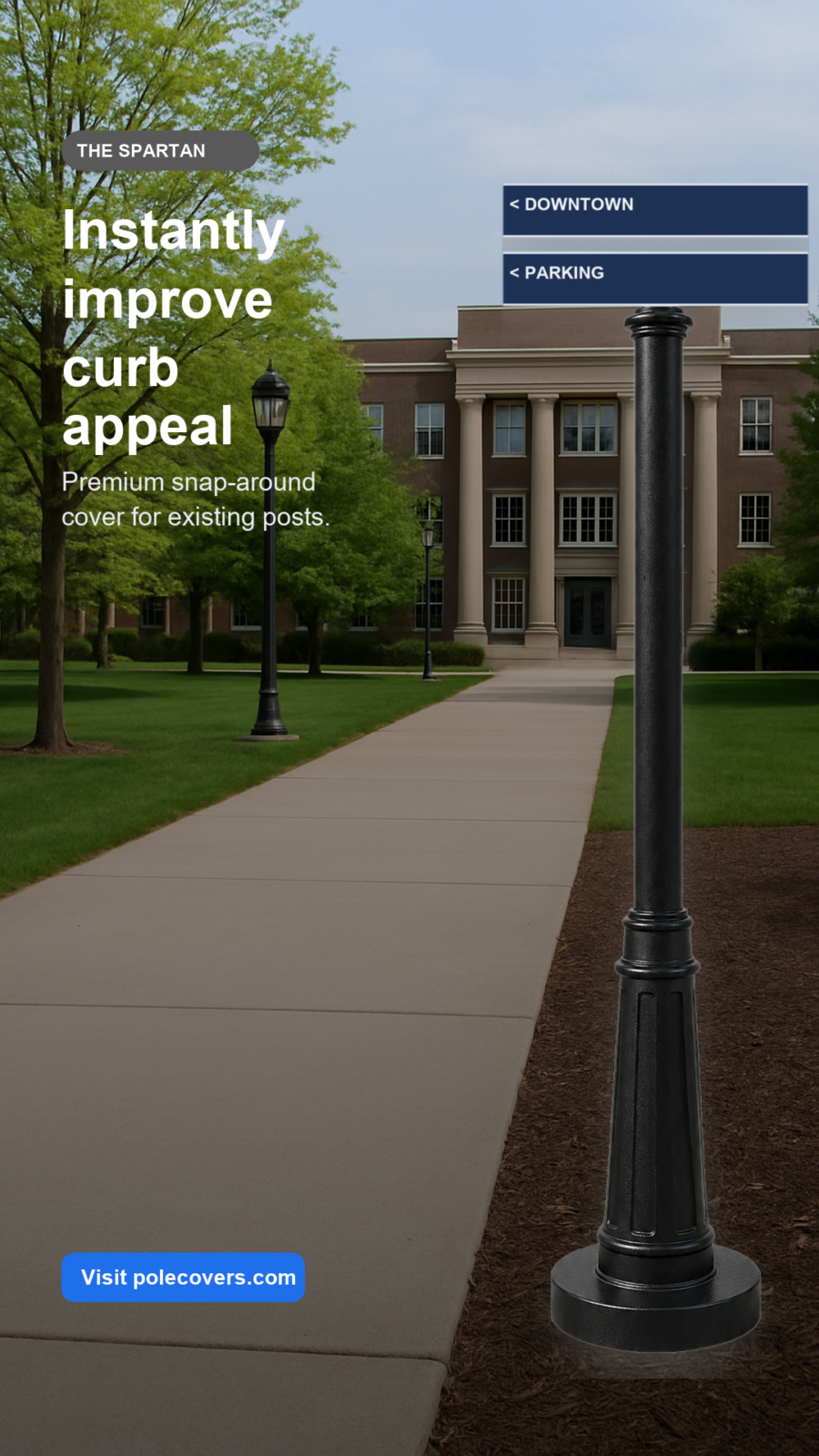
Pole Covers positions its products around that retrofit need. According to approved product information, Pole Covers are snap-around decorative plastic covers for standard sign posts, including U-channel, round, and square posts.
Just as important for public works planning, Pole Covers states that its covers install without replacing existing posts. For teams trying to minimize disruption, preserve existing sign infrastructure, or avoid more invasive field work, that is a meaningful planning consideration.
Where a product like Spartan fits
For municipal and public-works readers evaluating options, the most relevant product page is the Spartan Pole Cover.
Current approved product truth is narrow and should be stated plainly:
- there is one standard black Spartan Pole Cover
- custom color is only a 100+ unit feasibility discussion
That matters because streetscape products are often discussed in overly broad terms. Here, it is better to stay precise. If a team is considering a sign post cover as part of a wayfinding or downtown update, the standard starting point is black.
Why this matters in downtown and park-adjacent settings
Wayfinding systems do more than direct traffic. They help define whether an area feels intentional, maintained, and easy to navigate. In a downtown dog park context, directional signs may point users to entrances, rules, hours, pathways, or related amenities. In adjacent streetscape areas, those same signs become part of the district’s visual language.
That creates a practical design question: should the post remain a bare utility element, or should it contribute to a cleaner presentation?
A retrofit cover can be relevant when a team wants to:
- improve the look of standard sign posts already in service
- avoid the cost and disruption of replacing posts
- create a more finished appearance around civic, downtown, or park spaces
- coordinate the visible sign support with broader beautification goals
None of that changes the message on the sign face itself. But it can change how the overall installation is perceived.
A real municipal proof point to keep in mind
For readers looking for an approved municipal example, Pole Covers states that the City of McAllen, Texas deployed more than 200 Pole Covers across city facilities and downtown.
That proof point is useful because it speaks to municipal-scale applicability. It does not mean every city has the same needs, but it does show that the category is relevant in public settings where appearance and retrofit practicality both matter.
Questions specifiers and public works teams can ask early
When wayfinding signage is being planned or added, a few early questions can help determine whether post covers belong in the discussion:
1. Are existing posts staying in place?
If yes, a retrofit product may be more relevant than a full support replacement strategy.
2. Is the project trying to improve visual consistency?
If the surrounding area is being refreshed, bare posts may stand out more once new sign panels are installed.
3. Is field disruption a concern?
Products designed to work with existing posts may be easier to evaluate for low-disruption upgrades.
4. What post types are already in the field?
Since Pole Covers references standard U-channel, round, and square posts, existing conditions should be documented early.
5. Is the team expecting custom appearance options?
For Pole Covers, current approved guidance is one standard black Spartan Pole Cover, with custom color only as a 100+ unit feasibility discussion.
Using project signals the right way
The Portland dog park and wayfinding update is best understood as a market-context signal. Public reporting indicates signage activity tied to the space, including wayfinding added via the PSU sign shop and planned directional signs around Oak Savanna. For firms that design, specify, or maintain streetscape signage, that is enough to identify a relevant planning moment.
It is not enough to claim a product relationship, a sales opportunity, or a confirmed municipal buyer. Good municipal content should stay disciplined about that distinction.
So the takeaway is simple: when public spaces gain new directional signage, the sign-support aesthetic often becomes worth reviewing too.
A practical next step for municipal teams
If your city, downtown district, or public works department is evaluating sign-post appearance as part of a wayfinding or streetscape update, start with the product details that are actually confirmed.
Review the Spartan Pole Cover for the approved product information, and visit the Pole Covers homepage for broader company context.
For many municipal projects, the value of a retrofit-oriented solution is straightforward: improve the visible look of standard sign posts without replacing the underlying post infrastructure. When a project already includes new wayfinding, that can be the right time to decide whether the post itself should remain purely functional or become part of the finished streetscape presentation.
FAQ
Can sign post covers be added without replacing existing sign posts?
Yes. Pole Covers states that its covers install without replacing existing posts, which can make them relevant for retrofit-oriented streetscape work.
What product is relevant for municipal streetscape projects from Pole Covers?
For this topic, the relevant product page is the Spartan Pole Cover. Current approved product truth is one standard black Spartan Pole Cover.
Are custom colors available?
Pole Covers’ current approved guidance is that custom color is only a feasibility discussion at 100+ units. Content about other color options should not be assumed.
What kinds of posts can Pole Covers fit?
Pole Covers describes snap-around decorative plastic covers for standard sign posts, including U-channel, round, and square posts.
Why think about post appearance during a wayfinding update?
When a city or design team is already adding or reorganizing signage, it can be a practical time to review whether exposed post hardware aligns with the surrounding streetscape goals. Retrofit covers may help improve appearance without changing out the underlying posts.
Is the Portland dog park project a confirmed Pole Covers installation?
No. The Portland project is used here only as market context based on a public report about wayfinding signage and related streetscape updates. It is not presented as a Pole Covers customer, prospect, or installation.