Bloomington’s 2026 Neighborhood Improvement Grants Are a Useful Signal for Entrance Sign Upgrades
A recent Bloomington, Indiana project signal offers a practical reminder for HOA boards, neighborhood associations, and property managers: community entrance appearance still matters.
According to the cited public report on Bloomington 2026 Neighborhood Improvement Grants, grant-supported work includes refurbishing neighborhood entrance signs, including funding connected to the Prospect Hill Neighborhood Association. For property-management and HOA audiences, that matters less as a product story and more as a planning signal. Communities continue to invest in visible entrance features because those areas shape first impressions.
That does not mean Bloomington or Prospect Hill is a Pole Covers customer. It simply shows that entrance signage remains a real improvement category in neighborhood-focused funding and maintenance decisions.
Why neighborhood entrance signs get attention first
For many communities, the entrance sign area is one of the most photographed, most noticed, and most repeatedly seen parts of the property. Residents pass it every day. Visitors use it as a landmark. Boards often view it as a quick read on overall upkeep.
When a sign panel still looks acceptable but the post hardware looks dated or unfinished, the whole entrance can feel less polished than intended. That is where a retrofit-minded approach can become attractive. Instead of assuming the only solution is a full tear-out, some communities look first at whether existing sign posts can be visually improved.
What this Bloomington grant signal means in practical terms
The Bloomington grant story is relevant because it centers on neighborhood improvement and specifically includes entrance sign refurbishing in that conversation. For HOA and property-management readers, the takeaway is straightforward:
- entrance signage is a legitimate improvement priority
- visual upgrades do not always need to begin with full replacement
- curb appeal projects often focus on the details people see at eye level, including posts and hardware
That makes this a useful moment to audit existing streetscape signage and entrance structures across a portfolio or association.
A low-disruption way to think about sign post appearance
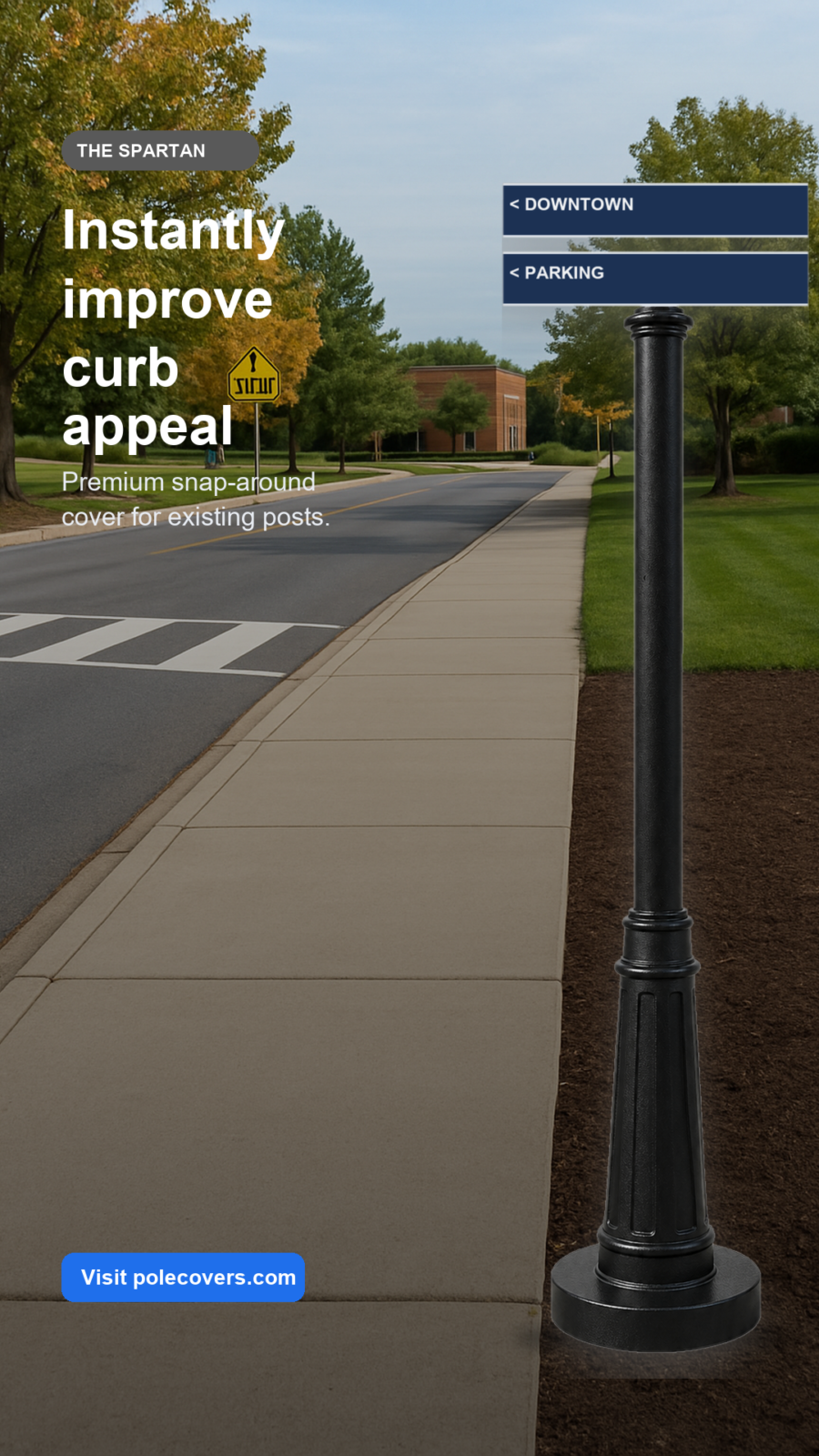
Pole Covers makes snap-around decorative plastic covers for standard sign posts, including U-channel, round, and square posts. In situations where the post is still in place and the goal is to improve appearance, that kind of retrofit can fit the need better than immediate replacement.
A key practical point: Pole Covers install without replacing existing posts. For boards and managers trying to improve curb appeal during routine maintenance cycles, that can matter. It supports a cleaner-looking upgrade path without turning every sign-area refresh into a full reconstruction project.
Pole Covers also positions its products as being designed for visible, low-disruption streetscape upgrades. That framing is especially relevant for neighborhoods, community entrances, and common-area signage where appearance is important but disruption is undesirable.
Where the Spartan Pole Cover fits
For readers evaluating options, the most relevant product page is the Spartan Pole Cover.
The current approved product truth is narrow and important to state accurately:
- there is one standard black Spartan Pole Cover
- custom color is only a 100+ unit feasibility discussion
That matters for specifiers and managers because it keeps planning grounded in what is actually available today.
If your community is reviewing sign areas, the Spartan page is the best place to understand the appearance-focused retrofit concept in more detail: https://www.polecovers.com/spartan/.
When retrofit thinking makes sense for HOA entrance projects
Not every entrance sign needs to be rebuilt from scratch. In many communities, the main issue is not that the sign location stopped working. It is that visible components look worn, overly utilitarian, or out of step with the image the neighborhood wants to present.
That is why retrofit products can enter the discussion when:
- the existing sign post is still in service
- the community wants a cleaner presentation
- the board wants to avoid unnecessary tear-out
- managers are trying to fit appearance improvements into normal upkeep work
This kind of approach can also help when a neighborhood is reviewing multiple sign locations and wants a more consistent look across entrances, common areas, or internal wayfinding points.
A real-world proof point for broader market confidence
For readers who want evidence that Pole Covers are used at meaningful scale, Pole Covers states that the City of McAllen, Texas deployed more than 200 Pole Covers across city facilities and downtown.
That proof point is useful because it shows the product category has been applied in a public-facing environment where appearance and consistency matter. It should not be read as a claim about Bloomington, Prospect Hill, or any unverified HOA project. It is simply an approved example of actual deployment.
Questions HOAs and property managers should ask during a sign audit
If the Bloomington grant story prompts your team to revisit community signage, start with a few practical questions:
1. Is the sign panel the problem, or is it the post appearance?
Sometimes the panel is still serviceable, but the supporting post creates a less finished look.
2. Can the community improve curb appeal without replacing existing posts?
If yes, a retrofit approach may deserve consideration before a full replacement budget is developed.
3. Are there several locations that should look more consistent?
Entrance signs, amenity signs, and neighborhood wayfinding can look disconnected when posts vary widely in appearance.
4. Is the board trying to minimize disruption?
That can make solutions that install over existing posts more appealing than alternatives requiring complete post replacement.
Using public project signals the right way
It is easy to overread a local funding story. The better approach is to treat it as a market-context signal, not a case study.
In this instance, the Bloomington article indicates that neighborhood groups and local stakeholders see value in entrance sign refurbishing. That is enough to make the topic relevant for HOAs and property managers elsewhere who are setting maintenance priorities or evaluating streetscape signage improvements.
It does not verify any purchasing relationship with Pole Covers, and this article does not suggest one.
The practical takeaway
The lesson from Bloomington 2026 Neighborhood Improvement Grants is not that every community needs a major reconstruction project. It is that entrance signage continues to be a high-visibility improvement area.
For HOAs and property managers, that creates a useful checklist:
- review whether entrance sign posts still support the image of the community
- consider whether retrofit options can improve appearance without replacing existing posts
- focus on low-disruption upgrades where routine maintenance and curb appeal goals overlap
If your team is assessing sign hardware as part of a neighborhood entrance refresh, start with the Spartan Pole Cover and review the broader Pole Covers site here: https://www.polecovers.com/.
In many communities, the fastest curb-appeal wins come from improving what residents and visitors already see every day.