What Des Moines Airport Wayfinding Signage Updates Signal for Public-Facing Sign Posts
A recent public project signal around Des Moines airport wayfinding signage updates and gate number changes points to a broader pattern that municipal and transportation teams already know well: when wayfinding changes, people notice every part of the experience.
That includes the obvious elements like gate numbers, directional signs, and messaging. But it also includes the supporting infrastructure around those signs. In highly visible public settings, sign-post appearance can affect how finished, organized, and maintained a site feels.
This is not about claiming any specific airport or agency is using Pole Covers. It is simply a practical lesson from a real public-facing wayfinding update. Across airports, train stations, government plazas, downtown redevelopment areas, and similar projects, wayfinding work often creates a moment to evaluate the full sign presentation.
Wayfinding projects put sign infrastructure under a brighter spotlight
When an organization updates directional signage, renumbers gates, or refreshes pedestrian guidance, visitors pay closer attention to the environment. That makes small details more visible.
For municipal and public works teams, that can raise familiar questions:
- Do existing sign posts still look presentable?
- Is exposed post hardware making updated signs look unfinished?
- Can the site be improved without replacing every post?
- Is there a way to clean up visible infrastructure with limited disruption?
These questions come up in more than just airports. The source evidence tied to this topic also references wayfinding-related improvements at a train station, a county office move involving interior and exterior wayfinding signage, and a downtown-style redevelopment corridor with streetlighting and wayfinding elements. The common thread is simple: when wayfinding changes, the surrounding sign system gets re-evaluated too.
Why post appearance matters in public-facing spaces
In municipal, downtown, and transportation-adjacent settings, signs do more than carry information. They also contribute to how a place feels.
Even when the sign face itself is updated, the supporting post can still look utilitarian or dated. That can be especially noticeable in places where visitors are already navigating unfamiliar routes, entrances, platforms, offices, or gates.
For public works and specifier audiences, the challenge is often not whether sign infrastructure matters. The challenge is how to improve it efficiently.
A full post replacement program may not fit the schedule, scope, or maintenance realities of a given project. In those cases, retrofit-oriented solutions may be worth reviewing.
Where Pole Covers fits into that conversation
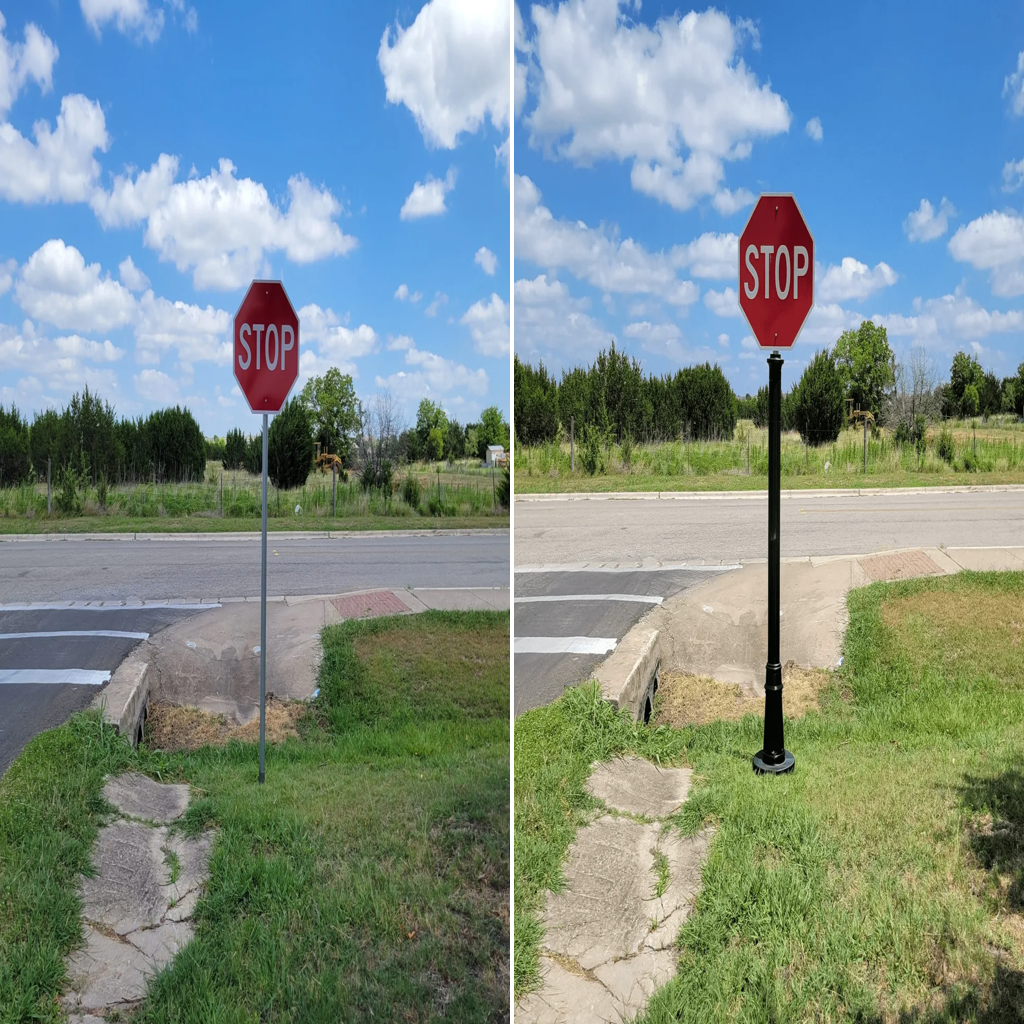
Pole Covers LLC offers snap-around decorative plastic covers for standard sign posts, including U-channel, round, and square posts. For teams looking at appearance upgrades, that matters because the product category is built around improving the look of existing posts rather than requiring replacement.
According to approved Pole Covers proof points:
- Pole Covers install without replacing existing posts.
- They are designed for visible, low-disruption streetscape upgrades.
- The City of McAllen, Texas deployed more than 200 Pole Covers across city facilities and downtown.
For municipal and public works readers, those are the relevant takeaways. If a site has visible sign infrastructure and the goal is to improve presentation without starting over, retrofit-friendly covers may be part of the evaluation.
You can review the product here: Spartan Pole Cover.
A practical fit for streetscape and facility-area upgrades
Wayfinding updates do not always happen as stand-alone sign projects. They are often bundled into broader public-environment improvements such as:
- downtown revitalization work
- facility access updates
- transportation-area reconfiguration
- plaza or campus navigation changes
- corridor improvements involving signs and lighting
In those mixed-scope environments, public works teams usually need options that work with what is already installed. That is where a product like Spartan becomes relevant as a specification or maintenance conversation.
Rather than treating the sign post as an afterthought, teams can evaluate whether the visible support structure should be cleaned up as part of the overall presentation.
Why low-disruption upgrades matter to public works teams
The strongest practical case for retrofit accessories is often not style alone. It is disruption.
Public-facing sites are busy. Crews may need to maintain access, minimize downtime, control labor complexity, and avoid unnecessary replacement of functioning infrastructure. If an existing sign post remains serviceable, replacing it may not be the preferred first move.
Pole Covers states that its covers install without replacing existing posts. For public works and municipal buyers, that supports a simpler question: can appearance be improved while keeping the current post in place?
That question is especially relevant in areas with many signs, recurring wayfinding updates, or streetscape zones where consistency matters.
Keep the product discussion accurate
For this topic, accuracy matters.
Current approved product truth for Spartan is limited to one standard black Spartan Pole Cover. If color comes up in a planning conversation, custom color is only a feasibility discussion for 100+ units. It is important not to overstate available options or imply unsupported finishes or variants.
That makes the right positioning straightforward: Spartan is a practical sign-post appearance upgrade option for existing infrastructure, with standard availability in black.
See the current product page here: Pole Covers Spartan.
What specifiers and public works teams can take from the Des Moines signal
The Des Moines airport wayfinding update is useful as market context because it reflects something happening across many public environments: wayfinding is not static.
Gate numbers change. Destinations shift. Public entrances move. Offices relocate. Downtown corridors are refreshed. Transit-adjacent areas get improved. And every one of those moments can create a reason to revisit how sign systems look in the field.
That does not mean every project needs a full replacement strategy. In many cases, the better question is whether the existing post system can be made to look more finished with less disruption.
For municipal and transportation-related environments, that can be a practical middle ground between leaving posts exposed and rebuilding the sign support entirely.
A useful evaluation framework
If you are reviewing a wayfinding or streetscape update, here are a few grounded questions to ask:
- Are the existing posts structurally staying in place?
If yes, a retrofit approach may be worth reviewing.
- Is the site highly visible to residents or visitors?
In public-facing zones, post appearance is easier to notice.
- Is disruption a concern?
Solutions that avoid replacing existing posts may simplify implementation.
- Is the goal a cleaner finished look rather than a complete redesign?
That is where decorative post covers may fit best.
- Do you need a proven municipal reference point?
Pole Covers cites deployment by the City of McAllen, Texas across city facilities and downtown.
Final takeaway
Des Moines airport wayfinding signage updates are one more reminder that public navigation projects often spotlight more than the sign face alone. In municipal, downtown, and transportation settings, exposed sign-post hardware can become part of the visual quality conversation.
For teams that want a visible upgrade without replacing existing posts, Pole Covers offers a retrofit-oriented option designed for low-disruption streetscape improvement.
To review the product, visit the Spartan Pole Cover page or explore the main Pole Covers website.
FAQ
Do wayfinding updates usually require replacing the entire sign post?
Not always. In many public-facing environments, teams may update sign faces, gate numbers, directional messaging, or surrounding streetscape elements without fully replacing the existing post. That is why retrofit-friendly accessories can matter when appearance improvements are needed with less disruption.
What kind of sign post improvement is practical for municipal or transportation settings?
A practical option is one that works with existing infrastructure instead of forcing a full tear-out. Pole Covers positions its products as snap-around decorative plastic covers for standard sign posts, including U-channel, round, and square posts.
Can a pole cover help when the goal is mainly visual cleanup?
Yes. For public works and streetscape projects, the goal is often to improve how exposed post hardware looks in visible areas. Pole Covers are designed for visible, low-disruption streetscape upgrades and install without replacing existing posts.
Is Spartan available in multiple standard colors?
Current approved product information supports one standard black Spartan Pole Cover. Custom color is only discussed as a feasibility conversation for 100+ units.
Where would a product like Spartan make sense?
It can be relevant anywhere sign posts are highly visible to the public, such as downtown streetscapes, municipal facilities, transportation-adjacent areas, and other wayfinding-heavy environments where teams want a cleaner finished look.
Is there any verified municipal deployment example from Pole Covers?
Yes. Approved proof points state that the City of McAllen, Texas deployed more than 200 Pole Covers across city facilities and downtown.