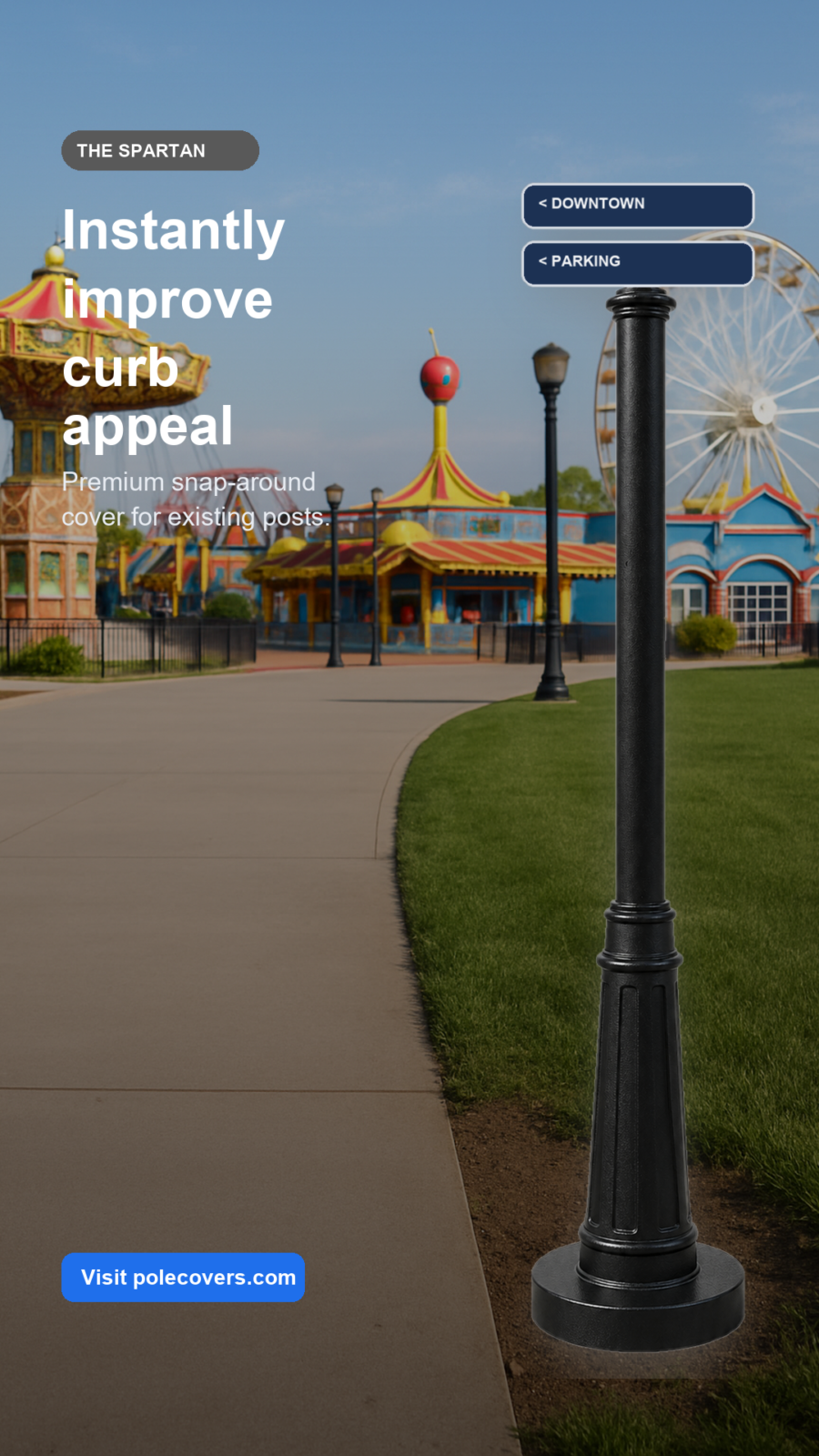
A public funding signal with a useful lesson for entrance signage
A recent public project signal from Moose Jaw, Saskatchewan noted that the city received RBC Barrier Buster Grants Program funding connected to wayfinding signage at the city entrance and related improvements. On its own, that announcement is local news. But for HOAs, property managers, and others responsible for entrance appearance, it points to a broader pattern: communities continue to invest in how arrival points look, read, and feel.
That matters because entrance signage is rarely judged on the sign face alone. Posts, hardware, and the surrounding streetscape all contribute to whether a gateway looks maintained and intentional or dated and pieced together.
For many communities, the question is not whether to improve signage. It is how to do it without unnecessary tear-outs, avoidable disruption, or a complete replacement of existing post infrastructure.
Why entrance and wayfinding projects get attention
Wayfinding and gateway signage sit at the intersection of function and appearance.
They need to:
- help visitors and residents navigate clearly
- support a consistent visual identity
- hold up as visible elements in common areas
- improve curb appeal at the places people notice first
That is true for a city entrance, and it is just as true for a neighborhood entrance, private community sign system, amenity area, or shared property wayfinding package.
When budgets are limited, teams often look for practical upgrades that improve the finished appearance of existing sign locations without rebuilding every post from scratch.
The overlooked part of streetscape signage: exposed sign posts
In many projects, sign faces get the design attention while support posts remain visually exposed. Even when the message panel is new, worn or plain posts can make the installation look incomplete.
This is where sign post covers can become relevant in planning discussions.
Pole Covers makes snap-around decorative plastic covers for standard sign posts, including U-channel, round, and square posts. For teams trying to improve the look of existing signage, that matters because the upgrade can focus on the visible post hardware rather than requiring immediate replacement of the entire support system.
Pole Covers also states an important practical point: Pole Covers install without replacing existing posts.
For HOA and property management teams, that directly aligns with a common maintenance goal: improve curb appeal during routine refresh cycles while limiting disruption.
Why low-disruption upgrades matter to HOAs and property managers
Community entrances and common-area signs are high-visibility assets. But they are also the kinds of assets managers often need to update while balancing resident expectations, vendor coordination, and budget discipline.
A full removal-and-replacement approach is not always necessary for every site. In some cases, the need is more cosmetic and presentation-driven:
- sign hardware looks dated
- post appearance does not match a refreshed entrance
- existing wayfinding signs need a more finished streetscape look
- managers want a cleaner presentation without major site work
In those situations, a retrofit-oriented approach can be worth considering.
Pole Covers positions its products as a way to support visible, low-disruption streetscape upgrades. That does not mean every project should use them. It does mean they belong in the conversation when a property is evaluating appearance improvements around existing posts.
Applying a municipal lesson to private-community entrances
The Moose Jaw funding announcement should be read as market context, not as a Pole Covers project. Still, it highlights a planning mindset that private communities can borrow.
When an entrance or wayfinding area is being improved, decision-makers can ask:
- Which elements truly need replacement?
- Which elements can be upgraded in place?
- Which visible details most affect first impressions?
- Can post appearance be improved during a normal signage refresh?
Those questions can help avoid overbuilding a scope when the real objective is a better-looking, more cohesive entrance.
For neighborhood associations and property managers, this can be especially useful at:
- monument-adjacent directional signs
- internal wayfinding signs
- amenity area signs
- parking and navigation signs in common areas
- entry corridor signage where exposed posts stand out
The product context: Spartan Pole Cover
For readers evaluating Pole Covers specifically, the relevant product page is the Spartan Pole Cover.
Per the approved product truth provided here, Pole Covers currently offers one standard black Spartan Pole Cover. Custom color is only discussed as a feasibility matter for 100+ units. So if you are comparing options, it is important to evaluate the product based on that current, approved offering rather than assuming a wider set of finishes or color choices.
That kind of clarity is useful for specifiers and property teams because it keeps early planning grounded in what is actually available.
You can also review the broader company information at Pole Covers.
A proof point for visible public-facing use
One approved proof point available for this content is that the City of McAllen, Texas deployed more than 200 Pole Covers across city facilities and downtown.
That matters because it shows sign post covers can be part of a visible public-facing upgrade strategy. It does not mean every property needs the same scale or scope. But it does reinforce the idea that post appearance is not a trivial detail. In many environments, it is part of how the entire sign system is perceived.
For an HOA or managed property, the same principle applies on a smaller scale: when entrance signs and directional signs look finished, the overall environment tends to read as more maintained.
What to evaluate before choosing sign post covers
If you are considering a streetscape signage refresh, a few practical checks can help:
Existing post types
Pole Covers are made for standard sign posts, including U-channel, round, and square posts. Start by documenting what is already installed across the property.
Visibility and priority areas
Not every sign location may need the same treatment. Focus first on entrances, main internal routes, and common areas where curb appeal matters most.
Coordination with sign-face upgrades
If wayfinding panels, parking signs, or directional signs are already being updated, that is often the right time to look at post appearance too.
Installation disruption
Because Pole Covers install without replacing existing posts, they may fit projects that want a more finished look while avoiding a full post replacement program.
Why this matters beyond aesthetics
For HOAs and property managers, entrance presentation affects more than appearance alone. It shapes how residents, visitors, vendors, and prospective buyers experience the property on arrival.
A sign system that looks complete and maintained can support:
- better first impressions
- stronger visual consistency across common areas
- a more intentional entrance experience
- incremental curb appeal improvements without full reconstruction
That is why even a city funding announcement about wayfinding can be useful context. It reminds us that signage projects are rarely just about words on a panel. They are about the total arrival environment.
A practical takeaway
The Moose Jaw announcement is one more indication that entrance and wayfinding improvements continue to matter in public-facing environments. For private communities and managed properties, the lesson is simple: when planning signage work, do not overlook the posts.
If your goal is to improve curb appeal without replacing existing sign infrastructure, sign post covers may be worth evaluating as part of a low-disruption upgrade path.
To review the product most relevant to this discussion, visit the Spartan Pole Cover page.
Frequently asked questions
What is the relevance of this funding announcement to sign post upgrades?
Funding tied to entrance improvements and wayfinding signage is a useful signal that communities continue to invest in how gateways and public-facing areas look and function. For property managers, HOAs, and public-facing site managers, it highlights the same practical question: how do you make existing sign infrastructure look more finished without turning a routine upgrade into a major reconstruction project?
Do Pole Covers require replacing existing sign posts?
Pole Covers are installed without replacing existing posts. That makes them relevant when a property wants to improve the appearance of sign hardware during maintenance or signage refresh work.
What product is most relevant for this kind of upgrade?
The relevant product page for this discussion is the Spartan Pole Cover. Pole Covers advises one standard black Spartan Pole Cover as the current product truth.
Are custom colors available?
Pole Covers states that custom color is only a feasibility discussion for 100+ units. Content about other colors or finishes should not be assumed.
Is this article saying Moose Jaw uses Pole Covers?
No. The Moose Jaw funding announcement is used only as market context related to city entrance and wayfinding improvements. This article does not state or imply that Moose Jaw is a Pole Covers customer, prospect, or buyer.
Where have Pole Covers been used at visible public sites?
One approved proof point is that the City of McAllen, Texas deployed more than 200 Pole Covers across city facilities and downtown. That example helps show that sign post covers can be part of visible streetscape upgrades.
Are Pole Covers only for cities?
No. The same low-disruption upgrade logic can apply to HOA entrances, neighborhood signage, common areas, campuses, and other properties where exposed sign posts affect curb appeal.