Why HOA entrance signs often need an upgrade before the posts need replacement
For many HOA boards and property managers, the neighborhood entrance is one of the most visible parts of the community. It shapes first impressions for residents, guests, prospective buyers, and service providers. But over time, even when the sign panel itself remains serviceable, the exposed sign posts and hardware can start to look dated, worn, or incomplete.
That creates a common maintenance challenge: the community wants better curb appeal, but a full sign replacement may not be necessary. In many cases, the real need is a cleaner, more finished appearance around the existing structure.
This is where HOA entrance sign improvements can become much more practical. Instead of planning a full tear-out, boards and managers can look at retrofit options that improve the look of existing sign hardware while keeping the current posts in place.
A curb appeal problem that shows up in routine maintenance
Entrance signs are often reviewed during broader property maintenance cycles. Maybe landscaping around the monument has been refreshed. Maybe paint and irrigation work are already scheduled. Maybe the community is trying to improve its image without expanding the scope into a full capital project.
In those moments, sign posts often stand out for the wrong reasons. Standard hardware may still function, but it may not support the polished look the HOA wants at the entrance or around common areas.
That is why many property managers search for a community entrance sign upgrade approach that fits into existing maintenance planning. The goal is usually straightforward:
- improve the finished appearance
- avoid unnecessary demolition
- limit disruption at the entrance
- make existing signage look more intentional
A retrofit solution can help meet those goals without turning a manageable update into a more involved replacement project.
Retrofit sign post beautification without tearing out what still works
When the existing post structure is still in place, replacing it can add cost, labor, and disruption that may not be needed. For HOA boards, this matters because entrance work often affects visibility, access, and resident perception while the project is underway.
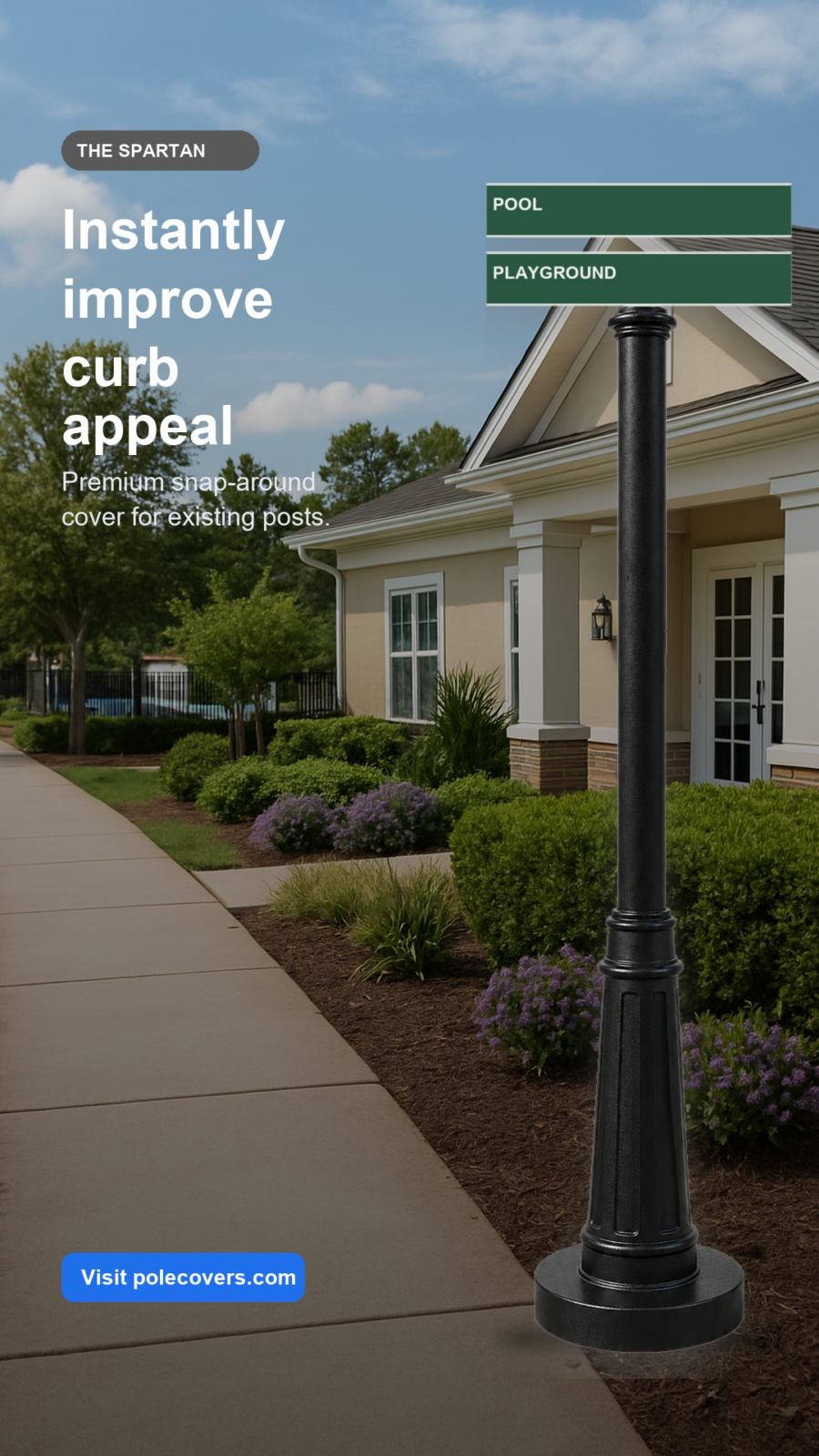
Pole Covers offers a way to approach retrofit sign post beautification more efficiently. Pole Covers install without replacing existing posts. That makes them relevant when a community wants to improve the look of sign hardware while preserving the existing support structure.
For property managers, that means the upgrade conversation can shift from “Do we need to rebuild this sign?” to “Can we improve the appearance of what we already have?”
That distinction is important. It gives HOAs a lower-disruption path to improving neighborhood presentation, especially where the sign face, site layout, or surrounding hardscape does not need a full redesign.
Why low-disruption upgrades matter at neighborhood entrances
Community entrances are high-visibility spaces. Work performed there is immediately noticed by residents and visitors. Even a worthwhile improvement can become frustrating if it requires avoidable disruption.
That is one reason retrofit solutions are often attractive in property management curb appeal planning. Pole Covers are designed for visible, low-disruption streetscape upgrades. For HOA and neighborhood signage, that design approach aligns with a practical need: make the entrance look better without creating a larger construction event than necessary.
This can be especially helpful when:
- the HOA wants a visible visual improvement during routine maintenance
- the sign location is near resident traffic flow
- the board wants to avoid replacing stable existing posts
- the property manager needs a cleaner finished look for common area signage
In short, low-disruption improvements can support both operations and appearance.
A more finished look for neighborhood entrance signage
For many communities, the issue is not that signage is missing. It is that the visible post hardware does not match the image the HOA wants to present. When entrance landscaping, lighting, and monument features are maintained but sign supports still look exposed or purely utilitarian, the overall effect can feel incomplete.
That is why neighborhood entrance signage upgrades are often less about changing the message and more about improving presentation.
Using HOA sign post covers can help create a more intentional appearance around existing posts. For boards focused on curb appeal, this type of update can help the entrance feel more aligned with the rest of the community’s maintained environment.
It can also support consistency across multiple sign locations, such as:
- primary neighborhood entrances
- amenity area signs
- directional signs in common areas
- community identification signage
For property managers, consistency matters because small visual mismatches across common areas can make maintenance feel less cohesive overall.
An example of proven use in visible public settings
When evaluating a product for visible exterior upgrades, decision-makers often want to know whether it has been used at meaningful scale.
One approved proof point from Pole Covers is that the City of McAllen, Texas deployed more than 200 Pole Covers across city facilities and downtown. That example shows the product has been used in highly visible public environments where appearance and streetscape presentation matter.
For HOA boards and managers, that does not replace project-specific review, but it does help show that this type of common area sign hardware upgrade is not limited to isolated use.
When this approach makes sense for HOA boards and property managers
Not every sign project should be treated the same way. If a structure is failing or the entire entrance design needs to be reworked, a larger replacement project may be appropriate. But many HOA sign upgrades fall into a different category.
A retrofit approach may make sense when:
- the existing posts are still in place
- the sign face or surrounding area only needs modest updating
- the board wants visible curb appeal gains without a full rebuild
- the property manager is coordinating improvements during normal maintenance cycles
In those cases, a product designed to fit over existing sign posts can offer a practical middle path between doing nothing and replacing the full support system.
How to evaluate HOA entrance sign improvements before your next maintenance cycle
If your community is planning entrance or common area updates, it helps to review signage with a few specific questions in mind:
- Are the existing posts still serviceable, even if they look unfinished?
- Is the real issue appearance rather than structural replacement?
- Would a retrofit solution help improve curb appeal with less disruption?
- Are there multiple sign locations where a more consistent finished look would help the property overall?
These questions can help boards and managers decide whether the best next step is replacement or beautification of what is already there.
For communities that want to explore a retrofit option, the Pole Covers Spartan product page is a useful place to start.
A practical path to better curb appeal
HOA entrances do not always need a complete rebuild to look better. In many cases, the opportunity is simpler: improve the visible sign hardware, keep the existing posts, and create a more finished appearance that better reflects the community.
That is why retrofit-focused HOA entrance sign improvements can be so appealing. They support curb appeal goals, fit well into routine maintenance planning, and avoid unnecessary replacement when the existing structure still works.
For HOA boards and property managers trying to improve neighborhood presentation without taking on a full tear-out, Pole Covers offers a low-disruption upgrade path designed around existing posts.
To learn more, visit the Spartan page from Pole Covers.