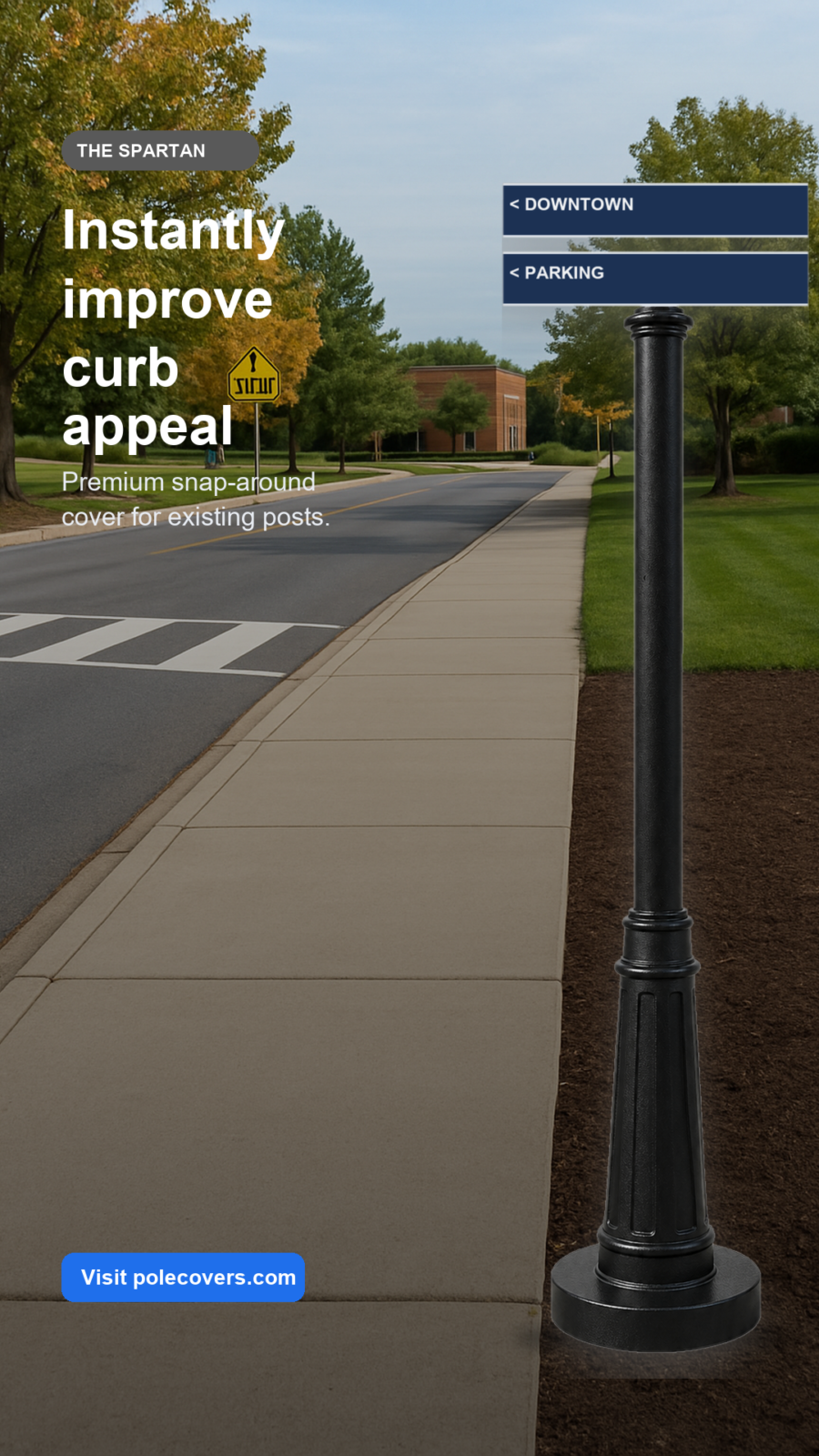
Directional signage / wayfinding and gateway signage projects often raise a second question: what should the posts look like?
When a city plans a directional signage, wayfinding, or gateway signage system, most of the discussion centers on sign design, placement, traffic flow, and district identity. Those issues matter. But once a project moves from concept to field installation, public works and planning teams also have to address a practical streetscape detail: the appearance of the sign posts themselves.
Even strong sign graphics can look less finished when mounted on exposed post hardware that does not match the surrounding streetscape. For municipalities trying to improve downtown presentation, gateway corridors, or public facility areas, that can become an important specification issue.
A recent project signal illustrates the market need. In Manchester, New Hampshire, the City of Manchester Office of Economic Development sought proposals for a new directional signage, wayfinding, and gateway directional signage system. That signal should be understood as context about the kinds of projects cities are actively planning—not as a verified Pole Covers customer relationship. Still, it reflects a common municipal challenge: once a city invests in wayfinding, it also has to think about how the supporting infrastructure contributes to the overall look.
Why post appearance matters in wayfinding and gateway signage
Wayfinding systems are meant to help residents and visitors move through a place with confidence. Gateway signage is often meant to signal arrival, reinforce identity, and support a more intentional streetscape. In both cases, visual consistency matters.
If the sign face communicates a polished civic identity but the post remains visibly utilitarian, the installation can feel incomplete. That does not always mean a city needs to replace every post. In many cases, the more practical question is whether an existing sign-post system can be improved with less disruption.
That is where retrofit-focused streetscape products can become relevant.
Pole Covers makes snap-around decorative plastic covers for standard sign posts, including U-channel, round, and square posts. For municipal and public works teams, the key point is straightforward: the covers install without replacing existing posts. That can make them worth considering in projects where the sign hardware is functional but the exposed appearance no longer aligns with the design intent.
A low-disruption option for streetscape signage upgrades
Cities often have to balance appearance goals with installation logistics. Full post replacement may add cost, coordination, and site disruption that is hard to justify when the existing infrastructure is still serviceable.
A retrofit approach can help in situations where the objective is to improve the visible finish of streetscape signage while keeping the underlying sign-post infrastructure in place. Pole Covers describes its products as designed for visible, low-disruption streetscape upgrades.
For directional signage and gateway signage projects, that can matter in several ways:
- it may help improve the visual presentation of existing sign posts
- it can support more cohesive streetscape signage in downtown or civic areas
- it avoids making post replacement the default answer when appearance is the main issue
- it gives public works teams a way to address exposed sign-post hardware during phased improvements
For teams evaluating options, the Spartan Pole Cover is the most relevant product page to review.
Where this fits in a municipal project workflow
Not every city starts from the same point. Some wayfinding programs are built as part of a larger downtown initiative. Others begin with a corridor plan, gateway strategy, or facility-area signage update. In either case, sign-post appearance often becomes clearer as a project moves closer to procurement and installation.
A practical planning sequence may look like this:
1. Define the signage purpose
Is the project primarily about downtown navigation, district identity, gateway markers, public facility direction, or a combination of these? The answer affects both sign design and the importance of consistent post presentation.
2. Review existing post conditions
If standard sign posts are already in place and structurally acceptable, a retrofit approach may be worth evaluating before specifying full replacement.
3. Coordinate visual standards with maintenance realities
Public works teams usually need solutions that can improve appearance without creating unnecessary field complexity. Products that install around existing posts may be easier to evaluate in that context.
4. Apply selectively where visual impact matters most
Some cities may prioritize gateway corridors, downtown blocks, civic campuses, or visitor-facing areas first. A phased approach can make sense when budgets and staffing are limited.
Real municipal proof point: McAllen, Texas
Pole Covers states that the City of McAllen, Texas deployed more than 200 Pole Covers across city facilities and downtown. That is a useful proof point because it shows relevance in a real municipal environment rather than a purely conceptual use case.
For municipal readers, the takeaway is not that every city should approach streetscape signage the same way. It is that retrofit-oriented sign post covers have already been used at meaningful scale in a city setting that includes both downtown and facility applications.
Important product clarification for specifiers
Because municipal buyers and specifiers often need exact product truth, it is worth being clear about the current Spartan offering.
The current standard product is the black Spartan Pole Cover. Custom color is only a feasibility discussion at 100+ units. If your project requires exact color matching, that should be evaluated early rather than assumed.
This matters in directional signage and gateway signage work because finish assumptions often make their way into early renderings or concept boards. Keeping the specification grounded in the currently available standard product can prevent confusion later.
You can review the current product information directly on the Spartan page.
A practical fit for streetscape signage discussions
For public works, planning, and downtown stakeholders, the value of a product like Pole Covers is not that it replaces the need for good wayfinding design. It does not. Sign location, hierarchy, legibility, and district planning still come first.
What it can do is support the finished appearance of the sign infrastructure already being used. In projects where directional signage, wayfinding, and gateway signage are intended to improve the public realm, post appearance is part of the outcome people actually see.
That is especially relevant when a municipality wants:
- visible streetscape improvement
- compatibility with existing sign infrastructure
- a lower-disruption alternative to replacing otherwise usable posts
- a cleaner presentation in downtown, civic, or visitor-oriented areas
For a broader overview of the company and product category, visit the Pole Covers homepage.
Final takeaway
The Manchester, New Hampshire project signal highlights an active municipal need: cities continue to invest in directional signage, wayfinding, and gateway systems to improve navigation and place identity. In that kind of work, the sign face is only part of the streetscape story.
If existing posts are still functional, a retrofit solution may be worth considering before a team defaults to replacement. Pole Covers offers snap-around covers for standard sign posts, including U-channel, round, and square posts, and they install without replacing existing posts. For municipal teams focused on visible, low-disruption streetscape upgrades, that makes them relevant to the planning conversation.
If you are evaluating options for sign post appearance in a wayfinding or gateway signage project, start with the Spartan Pole Cover product page.